Sunday, May 20, 2012
Short Story in the Style of Hemmingway
Pep Ventura turned the steel cranks. Sweat poured down his face. It was a large hill, but he would conquer it. He would conquer it like he conquered everything. Through sheer will-power and force of will. The cranks of the Raleigh squealed under his will. The rubber handlebar grips felt firm and confident in his sweaty hands. He liked this feeling. It was the feeling of triumph. He stopped for a drink at the top of the hill. Cresting this hill was a triumph. He was triumphant and he drank. Then he remembered drinking during The Republic.
The café was called El Siete-Onze. He would often cycle there. He remembered the cafes before the revolution where he played much PacMan and Asteroids and drank much slushy. He remembered the way the slushy was cold and hard in his hand. The cold hard icy feeling felt good. He longed to feel this again. It was a hard feeling, and it felt good in his hand. Now, the filthy fascist revolving slushy machines dispensed insipid creamy mixtures of passion fruit and lime. The moveable feast was gone. He obscenitied on these fascist flavours and their creamy coldness.
But those were the days before the Revolution, when things were good, and there was Maria. Maria always encouraged him to climb hills and write, for she was a strong woman. She encouraged him to write and would sit him in front of his typewriter and bring him some absinthe and a pitcher of ice water. The ice was hard and clear and cold, and the pitcher had water in it. The water was clear and cold from the ice. She would pour iced water into the green absinthe, and say “Now write!” He would look at his typewriter. It was a Remington. It was his favorite Remington. It had hard, firm keys and it went tapity-tapity-tap when he pressed them. He liked this. Their firmness felt good under his hand. It was a triumph. He loaded some paper into the Remington. The paper was white and pure and not recycled. He looked out the window at the green hills of Africa. He knew what it was to have and to have not, and Maria was all that kept him from knowing what it was for men to be without women.
But now there was no paper. The fascists had seen to that. There was only the blinking of the curser, and the quiet insipid pushing of keys. He looked at his hands, and the rubber grips of the handlebars. The wind caught his hair and a gleam of sunshine punched through the grey clouds onto his face. The writing would wait today, for there were still many green hills to climb. He pushed off on the Raleigh, and continued turning the steel cranks. Another cyclist passed him on the left and rang his bell. He knew for whom the bell had tolled.
.


Sunday, May 13, 2012
First Impressions of the Brompton Bicycle

The Brompton is a classic hand-built English folding bicycle designed by Andrew Ritchey in the 1970’s and manufactured in West London, and is one of the most cleverly engineered bicycles I have ever ridden. While the diminutive 16” wheels give it a rather eccentric appearance, the all-important ride quality compares very favourably with a traditional road bike. Since the position of the handlebars, pedals and seat are exactly the same as on a conventional bicycle, it is really only by looking down while underway that the fact the wheels are smaller is even noticeable. The entire basis by which a bicycle remains upright is that a spinning wheel develops a gyroscopic tendency to remain vertical, thus the inertial forces developed are sufficient to overcome the size difference of the wheel once underway, and presto-chango, the design works brilliantly. While the bicycle does handle differently at low speeds, the steering being very responsive, I actually found this a really welcome change to the somewhat sluggish and heavy steering of the Montague. Considering the wider size of mountain bike tires and their lower pressure, and the fact that the fork has heavy suspension components attached to it, it is not surprising that the far greater inertial mass makes for heavier steering. Just to clarify, it is not any more heavy than any other mountain bike, it’s just that compared to the light-weight Brompton steering, it is a very different sensation. While darting around London, through narrow passages and traffic calmed pedestrian areas, the quick steering and narrow handlebars were a very welcome feature.
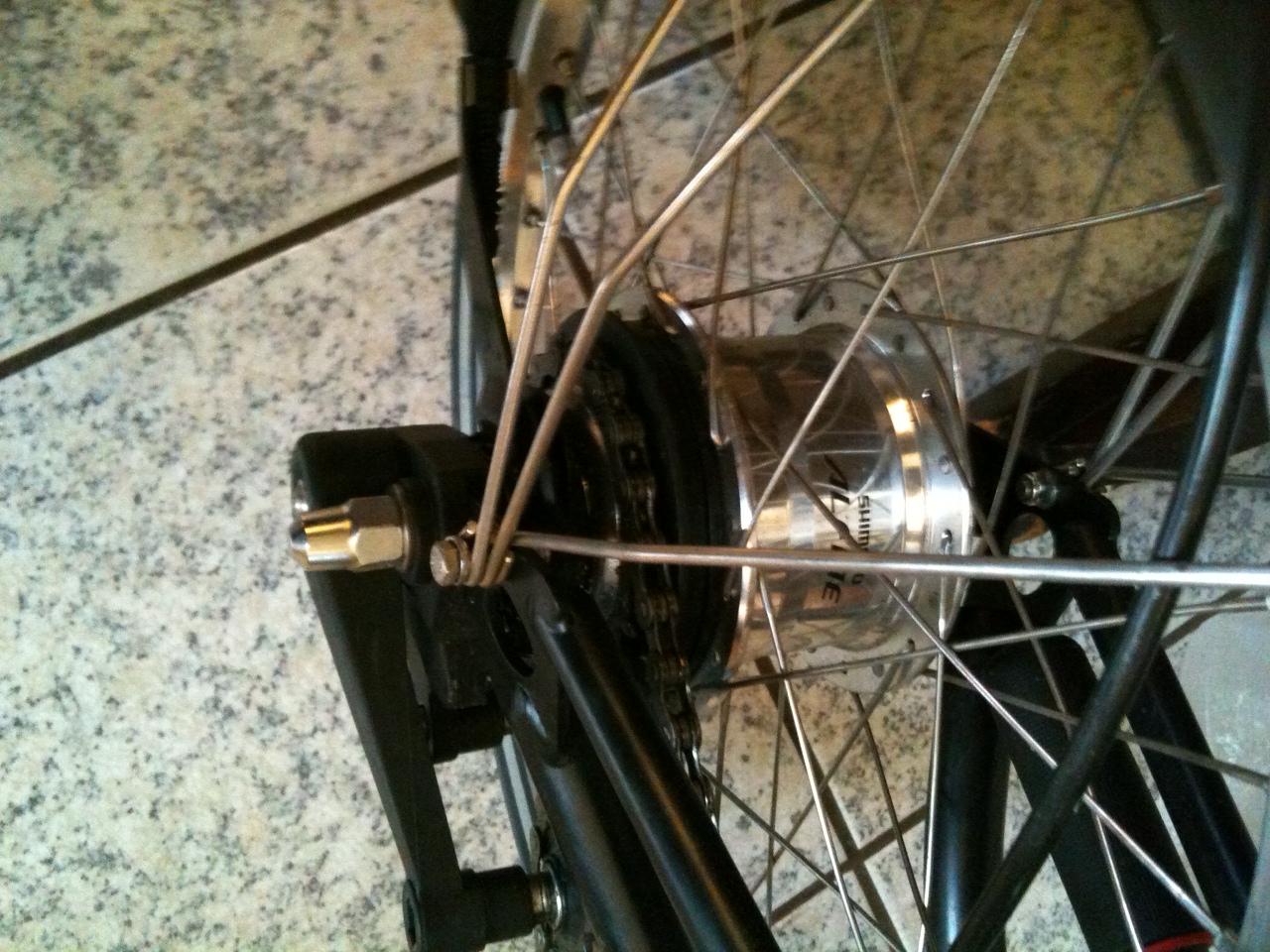

Even with the relatively wide range, the large steps implied by only six speeds would be an issue on longer tours. For this reason, I opted for an "S" model fitted with Shimano’s brilliant Alfine 11 speed internal gear hub, which is not an option Brompton offers. This arrangement gives a range of 409%, from the mid 20’s to just over 100 gear inches, and is thus ideal for touring. Top gears much over 100” are only for high speed descents, and while touring it is inadvisable to take such descents at speed, since by definition the terrain is unfamiliar. It is best to glide down at a moderate speed and simply enjoy the ride without pedalling. Unlike conventional triple crank/ seven cog set-ups on mountain bikes, the 11 gears of the Alfine are well spaced and distinct. A typical 21 speed setup might only give 12 or 13 useful and different gear ratios due to overlap, duplication, and gear combinations which should never be used (such as the smallest front gear with the smallest rear gear, the largest with the largest, etc. due to chain flex), so the Alfine is very comparable to this arrangement, but a major bonus is that all the magic happens inside an oil-bathed hub and the chain always travels in a straight line, thus minimizing maintenance and potential for damage and greatly simplifying the overall setup. The other magical thing about hub gears is that they can be shifted while at a standstill, or even while pedalling backwards. The ability to change gears while stopped is a useful feature since I seem to perpetually find myself in the wrong speed after stopping at a light. Yes, I know, lack of forward thinking...

The original gear shifters on the Brompton point up and require you to flick your thumb up and down to change gears. Having to shift the derailleur down and the three speed hub up in mid sprint did not impress me. Furthermore, there is an annoying disphase with respect to how and when both systems actually shift; don't expect both to react simultaneously. In practice, you shift one, wait for that gear to engage, then shift the other. Needless to say, I tried it and didn’t like it. While I have no doubt it is all very well engineered and the system rates high on the idiosyncrasy scale, in practice the setup is often referred to in cycling circles as "a cludge." In contrast, the Shimano system allows fast gear shifts with one finger without changing the position of your hand on the grips and brakes, and all the gears click through sequentially. I found the Brompton shifters fiddly and somewhat flimsy feeling, and overall having to deal with two shifters to get only six widely-spaced gears is rather ridiculous. In contrast, the push button rapid fire gear shifting of the Shimano is nothing short of fantastic; pushing one lever advances to the next gear, pushing the other decreases the gear. Both levers are two position, and pushing past the detente on each lever advances or reduces the hub by two speeds. An indicator on the handlebar points to the gear number as they're engaged. Ironically, this is a much simpler arrangement than Brompton's six speed set-up and almost doubles the gear options. As well, instead of four cables running off the handlebars, my bicycle only has three. While 11 gears will certainly be heavier than 3 gears plus a derailleur, in actual fact the difference is very minimal, just over a pound once all the components are accounted for. The difference in how the bicycle performs however is night and day and well worth the extra expense.

The brakes on the bicycle are adequate; don't expect the type of stopping power associated with a disc brake setup, and expect the usual fade in wet weather. A bigger concern might be what could happen after extended use of the brakes while descending long hills, or a long panic stop at speed. The smaller rims will likely not dissipate heat as quickly as a larger wheel, so heat build-up could be a problem, though likely not an issue in Vancouver where the brakes will inevitably be steamed vs. fried. I haven't cooked the brakes yet, but it's something to keep in mind while on tour, but it's nothing throwing an extra set of blocks into the travel bag won't solve.
 |
| A stock Brompton. Note position of gear shifters and abundance of cables. |
In terms of colour I was torn between satin black and the raw lacquer look. I had pretty much decided to go with the raw lacquer finish until I actually saw it in person, then I wasn't as sure. I thought the overall look, especially in the rear triangle made it appear rather home-made, and I had further misgivings about how the finish would stand up in the almost continuous rain and 100% humidity of Vancouver during every season except summer (and even then...). Would moisture migrate under the lacquer and start rusting out the steel frame? The satin black bicycle, at least to my eye, gave the most elegant and understated look.
 |
| Packed up for a trans Atlantic flight |
Once I arrived in Canada I further modified the bicycle by getting a slightly higher handlebar setup but used the original "S" type steering tube, which is the tallest of all the original stem. This arrangement ended up being only slightly higher than an "M" but lower than the new"H" - exactly perfect for me.
Another lucky accident was that with the clever Brompton seat clip inverted, the stock seat post is exactly the right height for me at full extension. As well, I installed more ergonomically comfortable handlebar grips; for such a high-end bicycle, the stock foam grips are not in keeping with the quality of everything else. I also switched the counter-intuitive British spec brake set-up (right hand activates the front brake) to the more usual configuration (right rear left front).
Finally, I fitted Brompfication's very excellent hinge plate set, which really should be standard issue on all Bromptons. Stock hinge plates are symmetrical such that you have to fiddle a bit to make sure they capture the two halves of the hinge. The Brompfication plates have one leg that is longer than the other, and a spring which pushes the plate out. Setting the hinge is just a one finger twist exercise, and probably reduces folding times by a second or two

During my visit, the fact that the bicycle folds into a tiny little package (22”x23”x10”) and with a bit of practice in less than 10 seconds allowed unrestricted access to the Tubes and the red Double-Decker buses, as well as being easily checked into the cloak rooms of the National Gallery, the National Portrait Gallery, the British Museum, the Victoria and Albert, and under the table at countless restaurants. I even took it with me to see Eugene O’Neill’s play “Long Day’s Journey into Night” starring David Suchet which was playing in the theatre district.
Even if you exclude the very remarkable folding feature, the bicycle in and of itself is a good ride and takes only a little getting used to. Like any bicycle, it does have its own share of idiosyncrasies, not least of which is the left folding pedal. While it is a very nice piece of engineering, the hinge upon which it folds makes it stick out just enough that I keep catching the edge of my shoe on it. This is likely a non-issue while wearing hard soled leather shoes rather than rubber soled casuals, and it's something you adapt to eventually.
My first long distance ride in Vancouver was on my usual weekend ride, from Burnaby Lake down the Kensington bicycle path to the Adanac corridor to Science World, along the waterfront to Stanley Park, around the park to False Creek, and along the cycle route out to Spanish Banks. After having lunch in Greek town, I took the reverse route to Kingsway, and took the SkyTrain cycle path out to Burnaby for a total run of around 60 kms.

My second ride involved taking the SkyTrain to Science World, and then meeting someone for dinner in China Town. The bicycle fit very nicely under the table at Foo's Ho-ho; the trick is always to get a table for four. Since I am very fortunate to have a SkyTrain station just over a kilometer away, I intend to utilize transit more and more, as traffic is getting insufferable downtown, and parking is terrible. The fact that the SkyTrain system is automated is another advantage since it avoids having to interact with idiot attendants who might not be aware of the bicycle’s folding characteristics. The technique I learned by observing other owners using the Tubes in London is to keep the bike unfolded for as long as possible so that it does not have to be carried around. Attendants there are well familiar with this bicycle and allow them to trundle through unmolested. Even still, normal bicycles are not allowed on the escalators of SkyTrain, (unlike Barcelona, where they are) so typically regular cyclists need to take the stairs, or the elevators when available. This is a stupid policy since gripping either brake lever as the bicycle goes up the escalator locks the bicycle in place. No doubt some bureaucrat or lawyer somewhere was having a bad day and decided cyclists should carry their bikes up the stairs because they could potentially roll down and KILL SOMEONE! Needless to say people like this should get a life and this obsession with litigation will inevitably make living here rather dull. Fortunately, the Brompton folds so small that it can be taken on an escalator and even allow people to walk on the left, though technically I'm breaking THE LAW and some lawyer somewhere is cringing. "So little of what could happen does happen" said Salvador Dali.


While the Brompton is not a mountain bike and must be handled just as one would a regular road bike, certain tricks are easily within the bicycle’s capabilities, such as doing short bunny hops onto or off of curbs. The bicycle handles normally on fine gravel paths, such as those which make up the cycle trails in North Burnaby, but it is not designed to cover technical paths, or stairs, which I routinely do on the Montague. Really the only disadvantage to the smaller wheels is that large irregularities such as pot holes and grills are more of a concern than on a mountain bike, though again, these are also significantly more dangerous on a road bike so there is likely little difference. The smaller wheels do have the welcome characteristic of accelerating faster, which makes hill-climbing a bit easier, though they do lose momentum quicker. Considering the non-competitive nature of my typical cycling excursions, loss of momentum is irrelevant; I tend to spin up hills in low gears and I could care less how fast or slow this ends up being. I rarely hike out of the saddle to climb hills. Brompton makes their own proprietary tires, and I’m currently running the Kevlar-lined model. My favourite tire that I run on all my touring bikes is the bullet-proof Schwalbe Marathon, and this is available in Brompton size, though it runs at a slightly lower pressure and has greater rolling resistance.
Overall, I am very pleased with the Brompton, and the relatively minor modifications which I made to outfit this bike to suit me used off-the-shelf components, so except for the simplified and expanded choice of gears by way of a custom laced rear wheel it's all pretty much DIY. I look forward to taking it on my next cycling tour which will likely be a round-the-world adventure. I intend on crossing the US, mostly by train, visiting many cities and exploring extensively, taking a boat to London from New York, a train across Europe to Venice, cycling through Italy to Brindisi, boating across to Patras, linking up from Istanbul across the Black Sea to Russia with the Trans Siberian Railway from Moscow, through Mongolia to Peking, then to Japan, and then taking a boat back to North America. Rather than going around the world on a bicycle it will be more like going around the world with a bicycle. Train travel is the most civilized form of transportation ever devised, and this bicycle is a perfect complement to that. It's ideally suited to people who like to take things at a slower pace and enjoy the immediacy of actually being in a place rather than driving through it. Having your own bicycle when exploring a city is a tremendous luxury, and not having to worry about getting it stolen is also very liberating.
The Brompton has the further advantage that the company makes their own line of proprietary luggage for just such extended excursions, as do various other companies, including the venerable Carradice of Nelson, who make a very nice traditional British touring bag out of waxed canvas and leather. I have one of these on order. Rather than panniers, which I never use, Brompton have adopted my preferred option, which is a large bag, similar to a 19th century valise, which clips directly onto the frame, thus not interfering with the steering, and distributing the weight on the bicycle evenly. On my last 1000km tour of the Via de la Plata in Spain I took along Rivendell's very excellent Sackville saddlebag, which at 23 litres is just right for credit card touring in Europe. Used with the Nitto hanger, the bag also converts into a valise. I'm not sure that I would use this setup on the Brompton, however, since it would put unnecessary diagonal stress on the seat post, and in any case the geometry of the Brompton is such that adding weight to the front actually improves the ride. In this respect, my collection of saddle bags is useless on this bike, due to the very long seat tube and the forces involved; down is good, sideways is bad.

Wednesday, April 18, 2012
A Moveable Feast

Paris, as Hemingway wrote, is a moveable feast, which is why I ended up handing out water bottles to Canadian runners during the Paris Marathon. It all started out innocently enough, the Latin Quarter,

Notre Dame, Sainte Chapelle,

a short walk over the bridge to Shakespeare & Co. to see which authors were reading. Shakespeare & Co. is my favorite bricks and mortar bookstore on the planet. This is probably true of almost anyone who has come here.

The first level has floor to ceiling shelves of books, all for sale, all in English and mostly literature, though there is a modest selection of everything else as well. The second floor is also floor to ceiling books, but not for sale, being a sort of library for the highly literate, and those who aspire to write.

There are a few spaces with, of all things, typewriters, and many places to sit or sprawl and read. The people who have written, read or stayed at one or other iteration of this bookstore include James Joyce, Ernest Hemingway, Gertrude Stein, Scott Fitzgerald, Ezra Pound, Ford Madox Ford and later, at this particular location, William Burroughs, Allan Ginsberg, and many other Beat Generation writers.


As well there is a piano. Anyone can come in off the street and hang out as long as they like, write a novel, play the piano, it's all very casual and happening and intelligent and it's possible to meet people who are astonishingly gifted. It is pretty much terra sancta with regards to who has spent time upstairs writing or who has spent time downstairs reading.

It was here that I met Nubilia, who was singing some Beatles tunes for a few Brits that were milling about. She had a lovely, if untrained voice, and singing English lyrics with an Italian accent added to the charm. Suddenly the pianist had to leave, and the Brits didn't leave, and I asked her if she knew any Pink Floyd, and she said she was a huge fan, so I sat in and played through most of the vocal numbers from Dark Side of the Moon, ending with Great Gig in the Sky. Nubilia did a brilliant job of the vocalise, so much so that a bunch more people gathered. I wanted to stop but everyone cheered us on, so after a bit of consultation we did a couple of Elton John numbers, then ended with the Louis Armstrong classic, Wonderful World. Someone asked if we took requests, and I looked at her and she looked at me and I just knew this was coming, "Do you know any Doors?" came the question from someone with a decidedly non-British accent. "Only if you'll sing along" I said, and that's exactly what happened, with a chorus of American, French, Italian, African, British, Canadian, Dutch, and probably many other nationalities singing Break on Through, Love Her Madly, Love Me Two Times, and so on... A curious thing happened as I was just getting into the extended keyboard solo on Light My Fire; a dude pulled up a chair and started improvising on top of my bass line, something very funky and in keeping with the piece, but this guy was really pounding some solid jazz chords. He motioned me to keep jamming, which I did, and he went off on some wacky wild tangent totally in keeping with the psychedelic-nightmare-carnival-keyboard-style of Ray Manzaric but also very jazzy. We probably extended that solo section to almost 20 minutes, then we each signaled that we should probably bring it home, and as I started in on the recap of the familiar riff, he played it as well but in Blues block chords, all very hyper cool! Then everyone sang the final verse, and there was huge applause, now the crowd being quite packed in and spilling down the narrow stairs. This was absolutely hilarious and we were all having a really intense fun time and I asked him where he was from. As it turns out Nathan is a jazz pianist from Montreal, and was here to accompany his girlfriend and a bunch of other Canadians who were running the Paris Marathon the next day. He played a couple more numbers solo, his own compositions, very cool and mellow blues, then when the group had thinned a bit we decided to all have lunch at the bistro next door. Despite my initial reluctance because I noticed the menu boards were in English, they assured me this place was cool, and it was. I guess I should stop being so paranoid about how Parisians treat tourists... They asked if I'd like to help hand out water to Canadians participating in the run tomorrow, and I said sure, and that's how I spent the next morning, on the lower banks of the Seine, looking out for shirts that had a red maple leaf on them and helping out with the distribution of water bottles. The things that happen in Paris...
I spent a great deal of time visiting galleries and museums, mostly studying paintings. The Louvre, unlike D'Orsay, has a very enlightened policy on taking pictures: knock your socks off, but no flash, which is very civilized indeed, considering the tumultous history of some of these paintings. While I took a few overall pictures of some paintings, mostly I took lots of extreme close ups, especially of some of my favorites, like the Vermeers. I hope in the future that museums will publish extremely high resolution pictures on-line so that aspiring painters can study them without having to travel vast distances. Nevertheless, the experience of actually seeing an important painting close-up is a tremendous luxury. From studying these paintings in art books one soon forgets how huge some of these are, like the Gericoult,

or how tiny, like Vermeer's Lacemaker, which is not much more than 7" square.

Needless to say I did not spend any time milling about trying to get a first row picture of the Mona Lisa.


This one is definitely worth seeing on-line or in high grade close-up in an art book. Still, as a cultural icon it is important to some people, a great many people, in fact, and this has the benefit of leaving all of the rest of Leonardo's works uncrowded. The recently discovered Prado copy of the Mona Lisa by one of Leonardo's Spanish apprentices is here at the special St. Anne exhibition which is on through May, and that copy is far more instructive with respect to the original in terms of colors, the background, the chair she's sitting on, her clothes, etc. Studying this painting one realizes just how damaged the original is, after hanging in King Louis' personal bathroom for many years. When the oils darkened someone took a scrub brush to it and took off her eyebrows. During the 19th century it was stolen, but eventually recovered, and every time the painting is taken down for cleaning, Paris holds its breath.
No visit to Paris would be complete without a walk up to Montmartre, and especially handy for me because that is where my hotel is.

The area is famous for all the painters that have lived and worked here, and many famous Impressionist works depict the area. Though there are still many painters who work here, they are by and large pretty lackluster, and I really wonder who it is that actually buys these paintings; tourists obviously, but why? Do they really not know any better? If so, why even come to Paris?


Maybe that's something I could do when I retire, live here and paint really bad Impressionist paintings for tourists.
Some more random photographs of the many hundreds I have taken can be found here.

Saturday, April 14, 2012
The Importance Of Being The Lizard King
I recently overheard a young American couple talking at a sidewalk cafe in Barcelona who were apparently on some sort of pre-packaged tour of Europe. The wife was of the opinion that people here were friendlier than in Florence. The husband asked "which one was Florence again?" The wife replied, "that's where we had that really bad sushi at the hotel, remember?"
People who understand the profound tragedy and horror (as in Conrad's character Kurtz "the horror..." ) of this cringe-worthy exchange will perhaps think I have joined that motley crew of unfortunates who routinely stumble through Europe, led by bored guides who could point to a Giotto and declare it to be a Delacroix and not generate so much as a raised eyebrow in response, when I describe my next pilgrimage site. Such are my travels that as well as taking in the important, the obscure, and those places that might only have meaning by virtue of what they historically represent, on this tour of ten pilgrimage sites I am also visiting places which have become important relatively recently, while ignoring the vacuous or sordid reasons why anyone would make a point of coming here in the first place.

Morrison is buried in a simple tomb at Cimetière du Père Lachaise in the 20th arrondissement. Whether he deserves to be buried in the company of such notables as Bizet, Balzac, Callas, Chopin, Delacroix, Modigliani, Piaf, Pissarro, Proust, Seurat, Gertrude Stein, Alice B. Toklas, Marcel Marceau and countless other greats is debatable. Nevertheless, so many hordes of American pilgrims, and others, have come here to pay their respects and leave mementos that damage has been done to adjacent tombs by those who routinely camp out overnight to sing Doors tunes by candlelight, holding spontaneous happenings, and generally making pests of themselves with their total disregard for the overall sanctity of the place. A tree nearby is covered in bubblegum as it is now some weird totemic part of the pilgrimage experience to "chew one for Jim". Needless to say it's a disgusting habit, but it seems to be tolerated in lieu of the damage which could be done to all the adjacent tombs. The thinking by some that this piece of ground is somehow American soil, and the frequent conflicts between the ground's keepers and the Mongol hordes of pilgrims who come to pay their respects have caused this tomb, of all others at Père Lachaise, to be a matter of continuous consternation. Morrison's tomb is now permanently guarded and fenced off to prevent graffiti, vandalism and such to other surrounding tombs, and while I was there I asked the guard, who appeared to be very bored and spoke with a raspy voice between long drags from the cigarette that precariously danced on his lips, if this was still an issue. Apparently not so much since they have tightened surveillance. However, he was of the opinion that of all the places to be buried at this cemetery, being anywhere near Morrison's grave was the worst, "un fiasc".





Subscribe to:
Posts (Atom)